What is “Coordination des Associations et des Particuliers pour la Liberté de Conscience” (CAP Freedom of Conscience)?
CAP Freedom of Conscience is a secular European NGO with United Nations Consultative Status, created in 1995 and dedicated to protect the Right of Freedom of Religion and Belief.
CAP Freedom of Conscience combats all forms of discrimination based on religion or belief by alerting European and International bodies.
CAP Freedom of Conscience collects testimonies of discrimination and human rights violations affecting religious or belief communities in order to disseminate them to international bodies, and in order to raise awareness and inform them as well as to generate debate on the protection of Freedom of Religion and Belief.
CAP Freedom of Conscience also advocates for any religious or spiritual group facing discrimination to have their right to Freedom of Religion and Belief recognized.
CAP Freedom of Conscience is a member of the European Federation for Freedom of Belief (FOB), European Network Of Religion and Belief (ENORB) and participate to the Civil Society Platform of Fundamental Rights created by the EU Fundamental Rights Agency DAFOH Partners in Combating and Preventing Forced Organ Harvesting
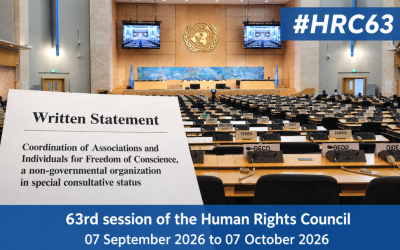
HRC 63 Written Statement: Minorities and the Long Road to Justice After Authoritarianism
Citoyens en action pour la démocratie et le développement and the Coordination des Associations et des Particuliers pour la Liberté de Conscience submitted this joint written statement during the 63rd session of the United Nations Human Rights Council, held from 7 September to 9 October 2026, under Agenda Item 8. The statement examines how victims of state violence can continue to seek justice when truth emerges slowly but procedural deadlines prevent the consideration of new evidence.
HRC 63 Written Statement: The Protection of Procedural Guarantees in the Case of Konstantin Rudnev in Argentina
Citoyens en action pour la démocratie et le développement and the Coordination des Associations et des Particuliers pour la Liberté de Conscience submitted this joint written statement during the 63rd session of the United Nations Human Rights Council, held from 7 September to 9 October 2026, under Agenda Item 4. The statement reports recent developments in the case of Konstantin Rudnev and raises concerns about procedural safeguards and Argentina’s international human rights obligations.
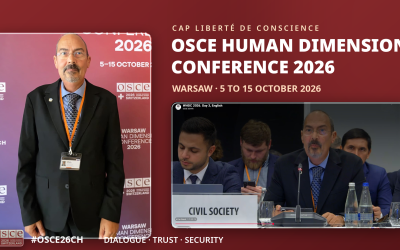
CAP LC at the Warsaw Human Dimension Conference 2026
CAP Freedom of Conscience participated in the Warsaw Human Dimension Conference 2026, represented by its President, Thierry Valle. This activity report presents the organisation’s contributions during the conference, including statements on the OneTaste case and the situation of Konstantin Rudnev, as well as written reports on academic freedom in Latvia and the MIVILUDES in France. It also covers the international side event organised with EMISCO on combating racism, xenophobia and Islamophobia, where Thierry Valle presented CAP LC’s concerns and recommendations. The report concludes with a selection of photographs documenting CAP LC’s presence and exchanges in Warsaw.
HRC 63 Written Statement: The Detention of Chairman Lee Man Hee in the Republic of Korea
The Coordination des Associations et des Particuliers pour la Liberté de Conscience submitted this written statement during the 63rd session of the United Nations Human Rights Council, held from 7 September to 9 October 2026, under Agenda Item 4. The statement expresses concern about the detention of Chairman Lee Man Hee, the 95 year old leader of the Shincheonji Church of Jesus, and its implications for elderly defendants, due process, and freedom of religion or belief.
HRC 63 Written Statement: Situation of Refugees from The Church of Almighty God
The Coordination des Associations et des Particuliers pour la Liberté de Conscience submitted this written statement during the 63rd session of the United Nations Human Rights Council, held from 7 September to 9 October 2026, under Agenda Item 3. The statement calls attention to the situation of refugees belonging to The Church of Almighty God and to the risks they face if returned to China.
HRC 63 Written Statement: Concerns Regarding the Application of Forced Labor Law to Religious Communities in the United States of America
Citoyens en action pour la démocratie et le développement and the Coordination des Associations et des Particuliers pour la Liberté de Conscience submitted this joint written statement during the 63rd session of the United Nations Human Rights Council, held from 7 September to 9 October 2026, under Agenda Item 3.
CAP Freedom of Conscience involvement UNITED NATIONS
LASTEST NEWS
Adhésion CAP LC 2024
CAP Freedom of Conscience involvement in Europe
SUPPORT CAP Liberté de Conscience
IBAN BE61 9670 0987 0017
SWIFT / BIC TRWIBEB1XXX
Address
TransferWise Europe SA
Square de Meeûs 38 bte 40
Brussels
1000
Belgium

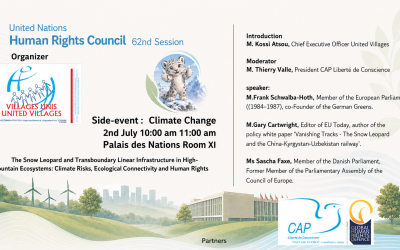
HRC 62 The Snow Leopard and Transboundary Linear Infrastructure in High-Mountain Ecosystems: Climate Risks, Ecological Connectivity and Human Rights
On 2 July 2026, from 10:00 to 11:00, United Villages will host a side-event at the Palais des Nations, Room XI, on the margins of the 62nd Session of the UN Human Rights Council. CAP Liberté de Conscience is proud to be a partner of this event.
The conference will explore the intersection of climate change, biodiversity loss, and human rights through the lens of one of the world’s most iconic endangered species: the snow leopard. The discussion will focus on the threats posed by transboundary linear infrastructure — railways, roads, and energy corridors — to high-mountain ecosystems, ecological connectivity, and the communities that depend on them.
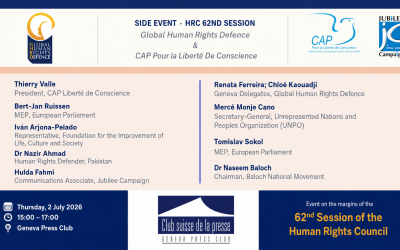
HRC 62 Forced Conversions and Minority Women in Pakistan: A Human Rights Emergency
UN experts document systematic abduction and forced religious conversion of minority women and girls in Pakistan. In 2025, 75% of victims were Hindu, 25% Christian, with 80% of cases in Sindh. Adolescent girls aged 14–18 are primary targets, facing abuse, stigma, and trauma. Baloch women face compounded ethnic and religious persecution. Co-organised by CAP Liberté de Conscience and Global Human Rights Defence, this HRC 62 side-event examines international accountability mechanisms and urgent protection measures.
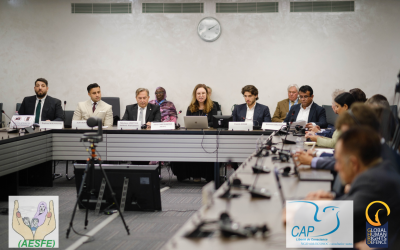
HRC 61 Side Event: Human Rights in Pakistan – Press Review
Discover why the European Union must urgently suspend Pakistan’s GSP+ status. MEPs and activists denounce systematic human rights violations, from the persecution of religious minorities to severe repression in Balochistan. While Pakistan benefits from EU market access, compliance with international conventions remains absent. This conference calls for immediate action to strictly link trade privileges with fundamental freedoms. Essential insights into the future of ethical trade relations and EU accountability.
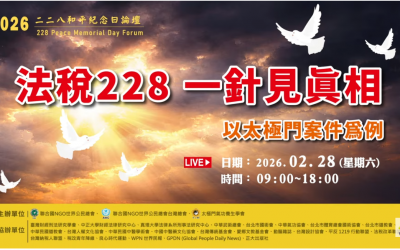
Conference 228 Incident : 228, the Tai Ji Men Case and the Unfinished Work of Justice
The 228 Incident warns against unchecked authority. Taiwan’s Tai Ji Men case reflects similar concerns: administrative actions contradicting court rulings undermine rule of law and religious freedom protections under international human rights standards
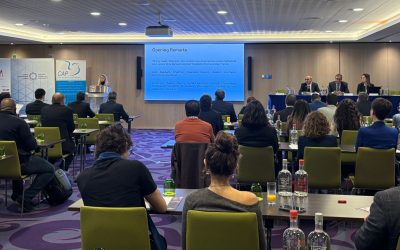
The Right to Return in International Law
jointly organized by CAP Freedom of Conscience and the Western Azerbaijan Community, with media support from Bruxelles Media.
The program brings together experts, policymakers, and scholars for focused dialogue, including conceptual framing, panels on cultural heritage and property rights, a documentary screening, and structured opportunities for exchange.
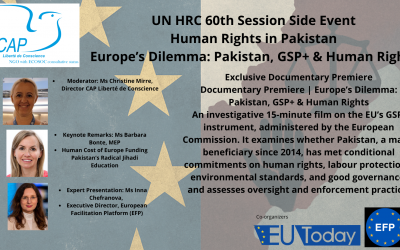
UN HRC 60th Session Side-event Human Rights In Pakistan
Documentary Premiere | Europe’s Dilemma: Pakistan, GSP+ & Human Rights
An investigative 15-minute film on the EU’s GSP+ instrument, administered by the European Commission. It examines whether Pakistan, a major beneficiary since 2014, has met conditional commitments on human rights, labour protections, environmental standards, and good governance, and assesses oversight and enforcement practice.